Aging affects not only the cardiovascular but also the immune system and the blood-forming hematopoetic stem cells in the bone marrow. Increasing evidence suggests that these processes are closely interconnected. However, the mechanisms through which vascular aging influences immune aging and vice versa, remain incompletely understood.
The THROMBO-MARROW-AGE project investigates how thrombo-inflammation, the close interaction between blood coagulation and inflammation, contributes to age-related changes in the cardiovascular system and the bone marrow. Our central hypothesis is that altered communication between vascular cells, immune cells, and blood-forming stem cells promotes both cardiovascular dysfunction and an increasingly inflammatory immune profile during aging.
Preliminary findings
Our initial studies indicate that the protease-activated receptor 2 (PAR2)-specific thrombo-inflammatory signaling processes may act as a molecular link between cardiovascular and immune aging. Modulating these signals in experimental models preserved cardiac and vascular function during aging and was associated with a more youthful composition of the blood-forming and immune systems. These protective effects extended to the bone marrow, where specialized blood vessels form a supportive microenvironment for hematopoietic stem cells. Our findings suggest that age-related changes in these vascular niches may contribute to dysfunctional stem-cell expansion and the increased production of inflammatory immune cells.
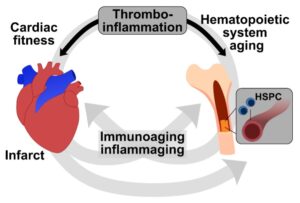
Together, these observations support the concept that cardiovascular aging and immune aging are not separate processes but are connected through shared cellular and molecular mechanisms.
Project aims
The project combines experimental, single-cell, and translational approaches in three interconnected research areas:
Mapping the underlying mechanisms
Advanced single-cell sequencing and molecular analyses will be used to characterize age-related changes in vascular, bone-marrow, and immune-cell populations. This will help identify the cellular interactions that connect vascular dysfunction with immune aging.
Studying the response to cardiovascular stress
We will investigate how aging and thrombo-inflammatory signaling influence the response to myocardial infarction. Particular attention will be given to cardiac repair, scar formation, vascular function, and the emergency production and mobilization of immune cells from the bone marrow.
Translating the findings to patients
In a clinical study of patients with acute myocardial infarction, immune-cell profiles and circulating biomarkers will be compared between younger and older individuals. This will determine whether the mechanisms identified experimentally are also relevant to human cardiovascular aging and may contribute to poorer recovery in older patients.
The Big Picture
By uncovering how blood vessel aging and immune aging are mechanistically linked through this one pathway, we hope to open new possibilities for treatments that protect both the heart and the immune system as we age and improve outcomes after events like heart attacks in older patients.
Principle Investigators
· Dr. Valentina Minciacchi, CTH, University Medicine Mainz (person of contact email)
· Dr. Michael Molitor, Department of Cardiology, University Medicine Mainz
