
Why GPR65 and GPR132 Matter in Lung Fibrosis Research
Pulmonary fibrosis is a devastating disease in which healthy lung tissue is progressively replaced by scar tissue, making it increasingly difficult to breathe. While existing treatments may retard the progression of the disease, they are unable to halt or reverse the disease process. Developing innovative treatments requires a deeper understanding of the fundamental biological mechanisms that drive fibrosis.
One of these mechanisms may lie in tissue acidification.
As inflammation and tissue damage progress, the environment within the lung becomes increasingly acidic. Immune cells detect these changes through specialized proton-sensing G protein-coupled receptors that translate shifts in extracellular pH into biological responses. Among these receptors, GPR65 and GPR132 have emerged as particularly promising candidates because they are predominantly expressed by immune cells—the key orchestrators of inflammation, tissue repair, and fibrosis.
This unique expression pattern places GPR65 and GPR132 at the intersection of tissue acidification, immune regulation, and chronic inflammation. Despite their considerable potential, the biological functions of these receptors in pulmonary fibrosis remain largely unexplored.
Recent analyses of single-cell transcriptomic datasets from patients with idiopathic pulmonary have revealed distinct expression patterns of GPR65 and GPR132 across immune cell populations, particularly macrophages and T cells. Building on these findings, the project will investigate how the expression and regulation of these receptors change during disease progression and how they contribute to immune cell function, tissue remodelling, and chronic inflammation in the fibrotic lung.
A particular focus of the project is the impact of aging—the strongest risk factor for pulmonary fibrosis. Understanding how aging affects proton sensing and immune regulation may reveal why the aging lung becomes increasingly susceptible to persistent tissue damage and irreversible scarring.
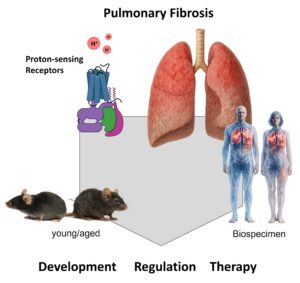
By integrating expertise in immunology, fibrosis research, aging biology, and advanced molecular technologies, the project aims to generate a comprehensive understanding of how the acidic tissue microenvironment shapes immune responses and disease progression.
The primary objective is to establish GPR65 and GPR132 as novel molecular targets for future therapeutic strategies. By uncovering how immune cells sense and respond to tissue acidification, the project seeks to pave the way for precision therapies capable of slowing, preventing, or even reversing the progression of pulmonary fibrosis.
Principle Investigators
· Dr. Toszka Bohn, Institute of Immunology, University Medicine Mainz (person of contact email)
· Priv. Doz. Dr. Sebastian Reuter, Department of Pulmonology, University Medicine Mainz
